
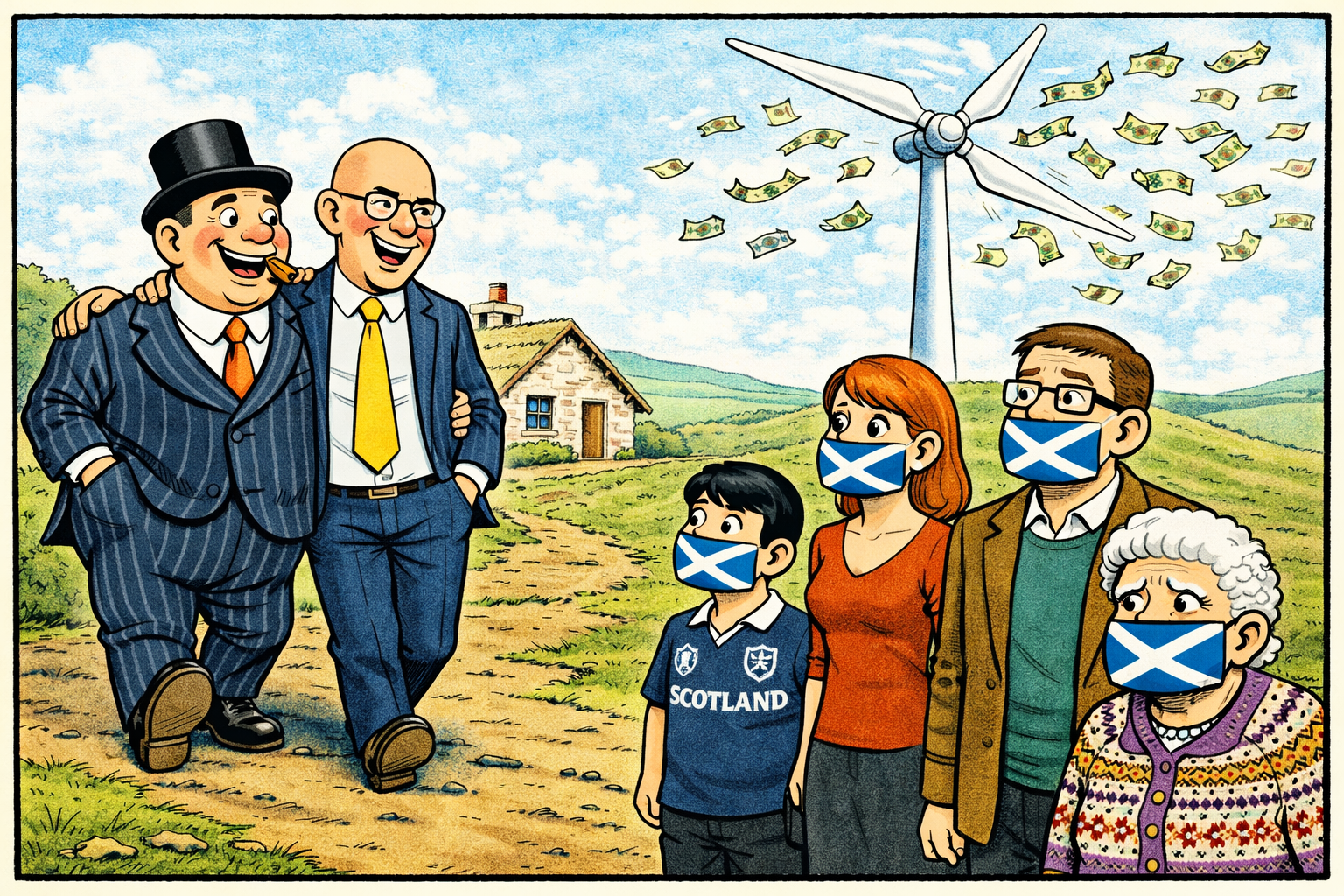
Give local communities a genuine voice on energy developments in their area.
Consultation to amend the Electricity Act, to increase the size of energy applications dealt with by local authorities such as Scottish Borders Council. It’s short and can be completed in a few minutes. Closing date is Friday 27th March 2026.
Only six questions: Onshore electricity generation: increasing the threshold for applications under The Electricity Act.
Background info on the consultation: Here
Scotland Against Spin response
Action to Protect Rural Scotland response
Please answer in your own words. Here are some pointers:
1. Should there be a single threshold applicable to all technologies?
Yes
No
No View
All energy planning applications should be decided by the local authority.
2. What threshold should apply for applications for electricity generation to be determined by planning authorities?
50MW
100MW
150MW
All energy planning applications should be decided by the local authority.
Most onshore energy applications now combine wind, solar or BESS and come to more than 150MW.
A threshold of 150MW would not restore local democracy to the energy planning system.
3. Any change to the threshold would apply only to new applications. Do you have any comments on transitional arrangements?
A new system of local energy decision making should apply to all applications, irrespective of where they are in the consenting system. Local authority planning departments have to research and assess these applications anyway. Local authorities should receive 100% of the fee to cover their additional costs. The current system where local planners do 99% of the work for 50% of the fee is unsustainable.
4. Do you have any other comments to add?
Energy Planning decisions must be made by local authorities in conjunction with the host community.
The current system is undemocratic. Under devolution the current Scottish Government has removed local consent from the energy planning process.
In England, all BESS applications are decided by the local authority. Also in England, from 2015 – 2024 onshore wind applications were only considered if they fitted with the Local Development Plan. The same local decision making for BESS and onshore wind should apply to Scotland.
Scotland already has an over capacity of onshore wind generation, relative to 3-4 GW of electricity demand. By September 2025:
7.6 GW onshore wind in construction or consented.
10.4 GW onshore wind built
18 GW onshore wind assured
20.9 GW BESS in construction or consented
No figures available for BESS already built in Scotland but cccording to NESO more BESS has been consented in Scotland than NESO has use for, decades hence.
1.8 GW solar PV in construction or consented
0.8 GW solar PV built
2.6 GW solar assured
Any additional onshore wind, solar or BESS now should be at the discretion of local authorities in consultation with local communities.
Please use the text box below to explain your view
For ease of understanding there should be one threshold for all technology types.
There is a risk that only raising the threshold to 150MW will cause potential developers to change tactics in order to game a new system. This could defeat the object. Assuming torities?
50MW no
100MW no
150MW yes
Please use the text box below to add any comment in support of your answer
The threshold must be increased to at least 150 MW. The threshold should also apply to each technology type per development – see answer to Q1.
If the threshold is per combined technology scheme, it should be much higher than the options given and should rise to 500MW. Only baseload (coal, gas, nuclear) power stations should be decided by ministers. Intermittent generation and storage should be decided at local authority level.
There is no need for any more onshore wind, solar or BESS in Scotland. With installed capacity up to six times demand, Scotland has more than fufilled its onshore wind energy obligations. Solar at this latitude adds little to no value. There is already more than enough BESS built or consented according to NESO. Any additional wind, solar or BESS capacity now should be at the discretion of local authorities in full consultation with local communities.
In England, all BESS applications are decided by the local authority. For several years all onshore wind applications were decided by the local authority. We recommend this system for Scotland.
3. Any change to the threshold would apply only to new applications. Do you have any comments on transitional arrangements?
Please use the text box below to explain your views
A new raised threshold should apply to all applications, irrespective of where they are in the consenting system. Local authority planning departments already bear the burden of researching and assessing applications. Local authorities should receive 100% of the fee to cover their additional costs. The current system where local authority planning officers do 99% of the work for 50% of the fee is unsustainable.
4. Do you have any other comments to add?
Please use the text box below to add any comment in support of your answer.
Energy Planning decisions under 500 MW must be made by local authorities in conjunction with thonsiders how we can reduce inequalities of outcome caused by socio-economic disadvantage, when making strategic decisions.
6. Do you have any suggestions for additional sources of information on the potential impacts of the proposals that could help inform our final assessments?
Please use the text box below to add any comment in support of your answer.
One response to “Onshore electricity generation – Electricity Act threshold: Consultation closing Friday 27 March 2026”
[…] Lauderdale Preservation Group and others argued that almost all energy planning decisions should be made by local authorities. You can read the LPG response here. […]