
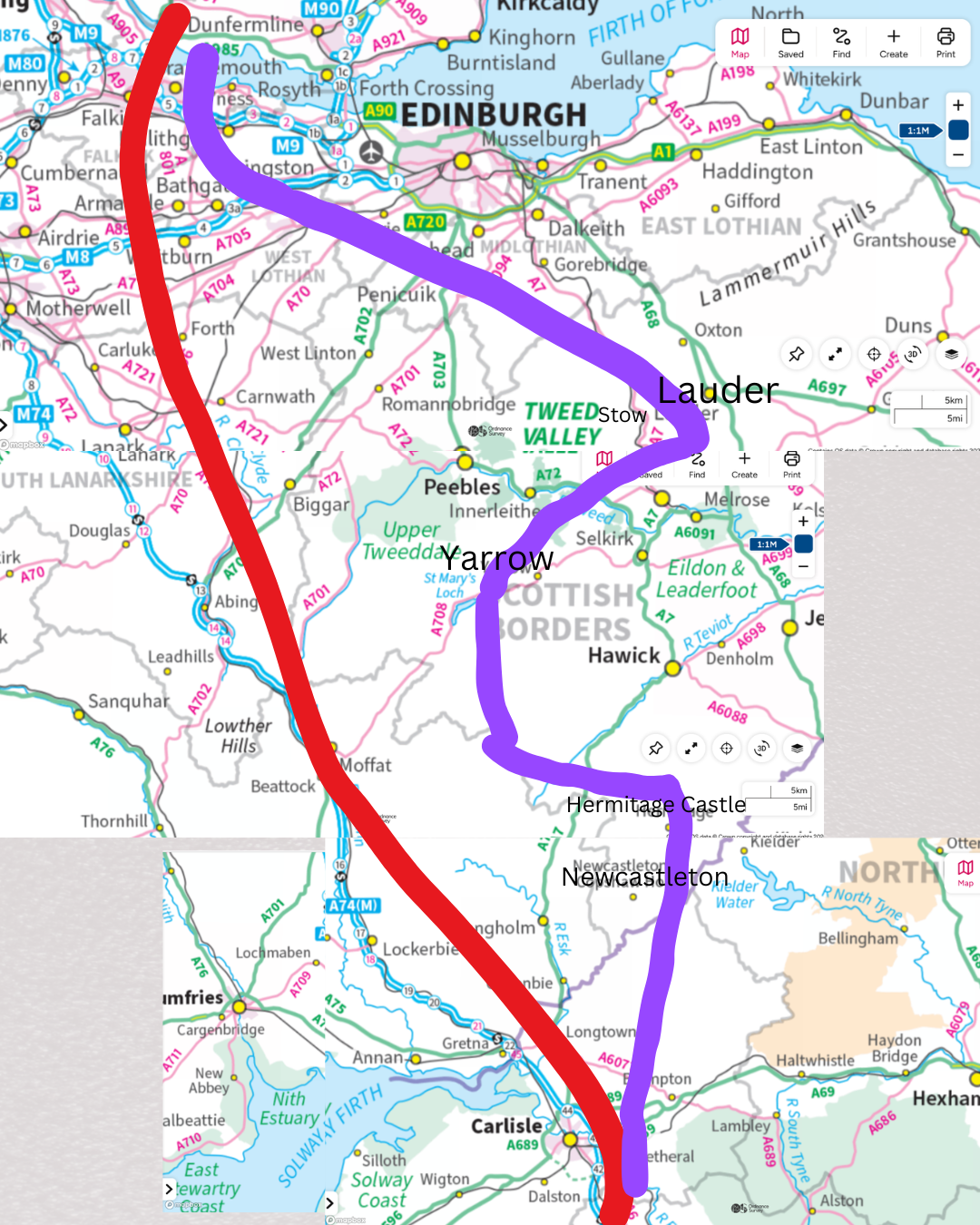
Red line – direct route from Kincardine to Carlisle via M74 corridor.
Purple line – SPEN’s proposed meandering route through the Scottish Borders. Not only would this longer line cost consumers more, it is intended to enable even more intermittent wind capacity behind the critical B6 bottleneck.
With NESO’s forecasts for transmission costs increasing, here are our observations of the various transmission schemes proposed for Lauderdale and the Scottish Borders.
Semantics
Upgrade and expansion are two different activities. Grid upgrade implies using new technology to make more of existing assets. Carbon core conductors and Dynamic Line Rating can add substantial additional transmission capacity to existing pylon lines Dynamic Line Rating is particularly apt as it can increase transmission capacity on windy days due to the cooling effect of the wind.
We are concerned with grid expansion, that is brand new infrastructure, and query the value to consumers.
Transparency
SP Energy Networks (SPEN) is a private monopoly, regulated by Ofgem. Given that Britain already has extremely high consumer and business electricity prices, we think SPEN should be obliged to explain what, if any, options appraisal it has undertaken.
In the SPEN region it is not clear whether they have fully utilised their existing grid upgrade capacity. The ZA line from Cockenzie to Eccles was recently re-conductored. We don’t know whether SPEN used the most advanced technology for this. SPEN has not published the before and after transmission capacity of this line.
Dynamic Line Rating has been dismissed out of hand by SPEN representatives when we have asked at public events. Apart from a small trial in Wales, we can find no other evidence of its use by SPEN.
In our experience of any discussions with SPEN there appears to be blurred responsibilities between SPEN and NESO in respect of decisions regarding new grid infrastructure. There is no clarity, no ownership of decision making and no technical justification for projects which will substantially add to customers’ bills.
Across six transmission projects that we are familiar with, SPEN has refused to divulge to us even basic technical information about the baseline, upgrades in hand and what net transmission capacity a new powerline in SE Scotland might add.
Boundary 6
NESO’s Boundary 6 is cited as a key bottleneck in the GB grid. SPEN gives various and conflicting reasons for building a new powerline through the Scottish Borders. On the website they say it is to carry offshore wind from the north of Scotland down to England. At public facing events they tell us a new powerline would be to enable additional renewable (mostly wind) generating capacity across the Borders.
It will not be possible to clear the B6 bottleneck if SPEN keep connecting significantly more generating capacity in Scotland.
Cost Benefit
The capital and operating costs of transmitting wind energy (including losses) to the consumer should be included when comparing new generation sites. Due to the intermittency of wind, the associated transmission lines are partially loaded for much of the time. Storing wind energy when it cannot be utilised is another substantial cost to customers.
DESNZ and the Scottish Government wish to add far more wind capacity than would be required if thermal generation (such as nuclear plants) were to be chosen. Such new wind capacity requires significant, costly additional transmission infrastructure.
Perverse Incentives
The Regulated Asset Base model means TO’s earn favourable returns on additional infrastructure long into the future. Equally, consumers are saddled with those costs by increasing Standing Charges which particularly hurt customers on low incomes.
Because of the entitlement to Constraint Payments there is no risk for wind developers building their projects somewhere with insufficient grid capacity to transport the energy. If the grid can’t cope, the wind operator is paid to switch off. This does nothing to encourage building capacity close to demand centres and where existing transmission facilities are adequate.
High electricity bills act as a regressive stealth tax on poorer households, particularly those just above the cut off and funding the various discount schemes. High energy bills also stifle economic activity, productivity and jobs. Any unnecessary transmission expansion will be detrimental to customers.
Part of the justification for network reinforcement comes from forecasts of rapid increases in electricity demand. These contrast markedly with the experience of falling demand over the past five years.